
Why does five-gallon capacity change the weekly coop routine so dramatically?
Penn State Extension’s small flock management guidelines document that laying hens consume approximately a quarter pound of feed per bird per day during active production. For a twelve-bird flock, that translates to three pounds of feed per day. A standard five-gallon bucket holds approximately twenty to twenty-five pounds of layer pellets depending on the formulation density, which gives that twelve-bird flock seven to eight days of supply between refills under normal conditions.Compare that to a one-gallon or two-gallon trough that requires daily refilling for the same flock size. Daily refilling creates a daily spillage opportunity, a daily pest attraction event, and a daily labor commitment that accumulates into a significant time burden across a full summer season when outdoor chores already compete for available hours. The five-gallon format removes daily refilling from the coop routine entirely for most small-to-medium flock sizes.What container and port specifications determine real performance?
Container material determines how well the system survives the outdoor conditions it operates in. Food-grade HDPE in a pigmented, UV-stabilized formulation is the material standard that handles sustained outdoor UV exposure, temperature cycling, and repeated cleaning cycles without degrading around port fittings or cracking at stress points across multiple seasons. Standard five-gallon hardware buckets meet this specification and cost three to five dollars each as replacements at any hardware store.Port diameter and height determine how well the gravity flow matches the natural eating pace of the flock. A port positioned two to three inches above the base of the container creates a controlled release that matches how laying hens actually pace their feed consumption through the day without pouring freely when birds peck at the opening. Three ports spaced evenly around the bucket circumference give multiple birds concurrent access, which distributes feeding activity more evenly across the day and reduces the competitive pressure at a single opening that single-port designs produce in any flock with a social hierarchy.How does installation work and what does the first fill look like?
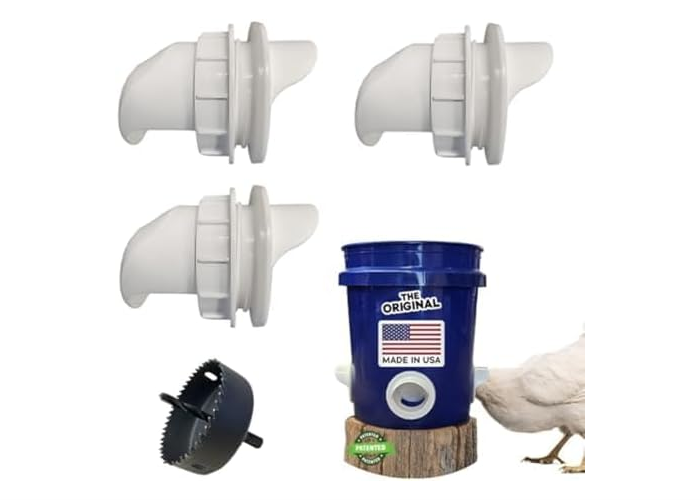
The Poultry Pro Feeder kit includes three precision-fitted ports and a matched hole saw bit, which eliminates the two variables responsible for most first-attempt failures in scratch-built designs: port diameter and container wall compatibility. The keeper provides a smooth-walled five-gallon HDPE bucket and a standard variable-speed household drill.Installation proceeds in a clear sequence from marking to first fill. Mark three port positions at equal intervals around the bucket at two to three inches above the base. Drill clean openings at each mark at moderate drill speed using the included bit. Press each fitting with firm, even pressure around the full circumference until the flange sits flush against the bucket wall with no visible gap. Fill the bucket, seat the lid, position the feeder in the coop, and run a brief check that feed flows at a controlled rate through each port before the flock accesses the system. Total installation time is typically under fifteen minutes.How does a five-gallon feeder pair with our complete poultry watering system?
The full benefit of the five-gallon format comes through when both the feeder and the poultry watering system run on the same standard bucket format and the same maintenance rhythm. Our Poultry Pro Waterer snaps onto any standard five-gallon HDPE bucket, maintains a consistent trough level through a gravity vacuum mechanism and connects to a standard garden hose for hands-free filling in under two minutes.What a coordinated five-gallon feeder and waterer pair delivers across an active season:- Matched refill intervals bringing both systems near-empty at approximately the same time, consolidating the maintenance visit into one session
- Shared container format standardizing replacement cost at three to five dollars per bucket for either system at any hardware retailer
- Anti-microbial waterer construction maintaining water quality between cleanings without chemical additives or daily rinsing
- Sealed port feeder construction keeping grain dry through rain, humidity, and direct heat regardless of overnight weather
- No mechanical components in either system that summer temperature cycling or humidity can degrade or jam mid-season
What does a full season look like with both systems running together?
The weekly routine for a keeper running both the Poultry Pro Feeder and the Poultry Pro Waterer from the same standard bucket format compresses significantly compared to managing either system separately or using older trough alternatives for both. Feeder refilling happens every seven to eight days for a twelve-bird flock. Waterer refilling happens every one to two days in peak summer heat, or every two to three days in moderate conditions. Both systems clean in one consolidated session using the same maintenance tools.Keepers who run both describe the same consistent outcome across their first full season: the coop floor stays cleaner, the feed budget drops within the first month, and the weekly coop routine no longer requires daily presence to manage equipment.Pet and Pen Designs Systems That Work While You Get On With Your Day
The Poultry Pro Feeder exists because backyard chicken keeping should be about the birds and the fresh eggs, not about daily grain management that a well-designed system makes unnecessary. Five-gallon capacity paired with three-port gravity access is the combination that makes that possible for most small-to-medium flocks. If your current setup is pulling you back to the coop every morning for something that should not require daily attention, our system changes that from the first fill.Frequently Asked Questions
1. How long does a full five-gallon feeder typically last for a flock of twelve birds?
At approximately three pounds of feed per day for twelve birds, a full twenty-to-twenty-five-pound reservoir typically provides seven to eight days of supply between refills under normal conditions.
2. Does the five-gallon format work for smaller flocks of four to six birds?
Yes. Smaller flocks simply refill less frequently, extending the interval to two weeks or more. The waste-prevention and pest-deterrence benefits apply equally regardless of flock size.
3. What type of bucket works best with the Poultry Pro Feeder ports?
Smooth-walled food-grade HDPE five-gallon buckets from major hardware retailers are the recommended container. Textured, ribbed, or thin-walled containers prevent clean port seating and are not compatible.
4. Can the Poultry Pro Feeder be used indoors as well as outdoors?
Yes. The sealed design works in both indoor and outdoor environments. Outdoor use benefits most from the weatherproofing that the sealed lid and UV-stabilized port materials provide against direct sun and rain.
5. Is the hole saw bit included in the Poultry Pro Feeder kit reusable for future builds?
Yes. The hole saw bit is a standard drill attachment that can be used for additional feeder installations or replacement bucket drilling as needed beyond the initial kit installation.